| Apr 27, 2006 - Potosí, Bolivia
| (click to enlarge)
 |  | (click to enlarge)
 | | (click to enlarge)
 | | (click to enlarge)
 | Pedestrian walkway and Cerro Rico in back
| | Another of the street and mountain
| | Potosi's central plaza
| | This is not a pedestrian-only street
| (click to enlarge)
 | | (click to enlarge)
 | | (click to enlarge)
 | | (click to enlarge)
 | You can see the cars in this one
| | Another from this busy street
| | One last one with the big crowds
| | Potosi market with a church in the background
| (click to enlarge)
 | | (click to enlarge)
 | | (click to enlarge)
 | | (click to enlarge)
 | The church
| | A Potosi local in typical dress
| | Here she is again on a street corner
| | Another section of Potosi
| (click to enlarge)
 | | (click to enlarge)
 | | (click to enlarge)
 | | (click to enlarge)
 | Potosi's space needle with revolving restaurant on top
| | Cerro Rico and its church
| | Another interesting church in Potosi
| | Old archway framing the Cerro Rico
| (click to enlarge)
 | | (click to enlarge)
 | | (click to enlarge)
 | | (click to enlarge)
 | Central plaza again and another church, in repair
| | Old bell tower and Cerro Rico
| | Relaxing on the street
| | Looking back to the city from Cerro Rico
| (click to enlarge)
 | | (click to enlarge)
 | | (click to enlarge)
 | | (click to enlarge)
 | The church on Cerro Rico
| | In my mining gear
| | Inside the mines, workers hauling out the days find
| | Touring through the mines
| (click to enlarge)
 | | (click to enlarge)
 | | (click to enlarge)
 | | (click to enlarge)
 | Fuses from dynamite stuck in the walls
| | An opening to a passageway on a higher level of the mine
| | A worker talking through a hole in our ceiling
| | Those shiny flakes are the what they're after
| (click to enlarge)
 | | (click to enlarge)
 | | (click to enlarge)
 | | (click to enlarge)
 | A "vein" rich in mineral
| | Tour guide and some others chillin in the mines
| | The deity of the mines
| | He is said to like tobacco and coco leaves
| (click to enlarge)
 | | (click to enlarge)
 | | (click to enlarge)
 | | (click to enlarge)
 | Potosi Panorama 1
| | Potosi Panorama 2
| | Potosi Panorama 3
| | Potosi Panorama 4
| (click to enlarge)
 | | (click to enlarge)
 | | (click to enlarge)
 | | (click to enlarge)
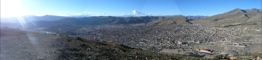
 | Completed panorama Potosi
| | The church on Cerro Rico closer up now
| | Me with my dynamite supplies
| | Preparing the fuse
| (click to enlarge)
 | | (click to enlarge)
 | | (click to enlarge)
 | | (click to enlarge)
 | A green stick of soft dynamite
| | Putting it all together
| | Helping set up the contraption
| | Another pic of the same thing
| (click to enlarge)
 | | (click to enlarge)
 | | (click to enlarge)
 | | (click to enlarge)
 | That's a lit fuse of live dynamite around my neck
| | My guide placing the dynamite far away
| | Waiting for the explosion (couldn't time the photo right)
| | Another scene of Potosi's outskirts
|
| Potosi is one of the main Bolivian stops on the gringo trail. At 4070 meters it is the highest city of its size in the world. Year round it is absolutely freezing when the sun is not shining, but a quick glimpse at its history explains why a large city was developed in this desolate environment. In 1545 Cerro Rico ("rich hill") was discovered to have large amounts of silver, and a mining boon quickly erupted. Soon Potosi became the largest and richest city in all of South America, and was a major world force like New York, Paris, and London today. I'm not going to do justice to the turbulent history of this place, but if you are interested it is fascinating. The need for labor qickly accelerated the slavery industry in the region, and even changed the Catholic church's official stance on coco leaves. As I've mentioned in other entries, coco leaves are a major product and staple of high andean life especially by the native cultures. It is the plant that eventually becomes cocaine, and due to its strong effects the Catholic Church originally banned it is demonic and evil. Once they saw the effect it had on mine workers, however, they changed their mind and even required all workers to chew a daily supply of the leaves that provided them more energy, less succeptibility to altitude, and a supressed appetite. Eventually in the early 1800's the mines were stripped dry of their silver, yet to this day are still mined for any and all other materials they can find such as lead and zinc. The conditions have changed little since the initial days of mining in Potosi, and over 8 million people have died as a result of working in the mines.
This Cerro Rico has also helped generate business in the area's newest industry, tourism. People come here to view a city steeped in history yet trying to propel itself into the future. For a few dollars you can tour the mines with a guide and see the appaling conditions first hand. For less than a dollar you can buy your own live dynamite and explode it outside of the mineson the side of the hill. Stories of this type of tourism from other travellers is what made me take a stop in Potosi, however short it was.
I arrived around 5am in the dark and bitter cold, made my way to a hostel and got into bed for a few hours of needed sleep. My late morning then consisted of no more than setting up my tour with a company, walking around the city a bit (remember I stopped through here briefly back in November on my day-long epic journey to Uyuni), and getting some food. In the afternoon I got suited up in the mining gear along with the other tourists and our guide led us on a brief and somewhat disappointing tour. I had heard from others stories of really eploring the depths of the caves, crawling through tight spaces, climbing rickety ladders, and chatting with the mine workers about their daily lives. My tour seemed more to just hint at the possibility of these things, took a quick peek inside the mines and at the statue of the deity of the mine that the workers all make sacrifices to. Before starting we go to the miner's market where we buy gifts to bring to the workers (soda, oranges, cookies, explosives). I did get to blow up some dynamite at the end, which was cool, and then it was a scramble for the rest of the afternoon to make my evening bus to La Paz. Yep, I was off in a rush yet again. I got back to the hostel, had a quick hot shower (thankfully), and rushed out for a great steak dinner. By about 7pm I was at the bus terminal, for the third consecutive night preparing to get my sleep on a bus.
A quote from Lonely Planet about the mines:
"Working practices are medieval, safety provisions are nonexistent and most shafts are unventilated... Work is done by hand with basic tools, and underground temperatres vary from below freezing to a stifling 45c (113F). Miners, exposed to myriad noxious chemicals, normally die of silicosis pneumonia within 10 years of entering the mines. They work the mine as a cooperative venture, with each miner milking his own claim and selling his ore to a smelter through the cooperative." |
| |
| |


